
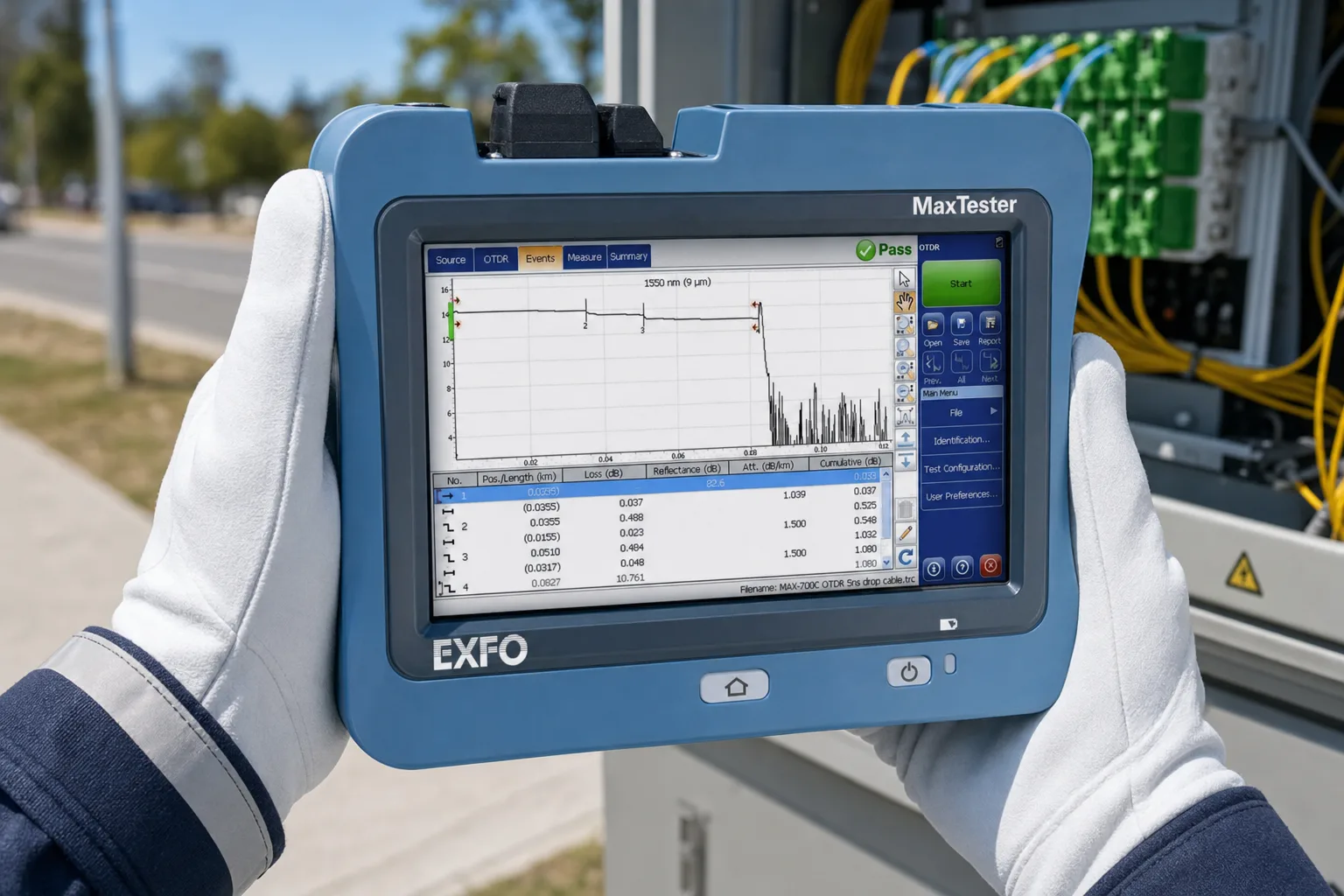
An Optical Time-Domain Reflectometer (OTDR) is a portable fiber optic test instrument that sends a series of optical pulses into a fiber and analyzes the reflected and backscattered light to characterize the entire link. It is the fiber industry's equivalent of a network analyzer — in a single trace it reveals total loss, splice and connector losses, and the precise location of every event.
How Does an OTDR Work?
The OTDR launches narrow laser pulses (commonly at 1310, 1550 and 1625 nm for single-mode fibers) and samples the Rayleigh backscatter along the fiber. By correlating returned power with time of flight, it builds a distance-vs-attenuation curve. Splices appear as small steps down, connectors as localized reflections with a loss, and fiber breaks as a large reflective event with no signal beyond.
What Can an OTDR Test?
- End-to-end optical loss (dB) of the entire fiber link
- Fiber length and exact event distances
- Splice loss and connector insertion loss
- Return loss / reflectance of each reflective event
- Macrobends, fiber defects and break locations
Where Is OTDR Used?
OTDRs are used across FTTx construction acceptance, long-haul backbone commissioning, data center fiber certification, CATV maintenance, and emergency fault location. Carriers also use OTDRs with launch cables and tail cords to fully characterize the first and last connector of a link.
Main OTDR Types
Handheld OTDR
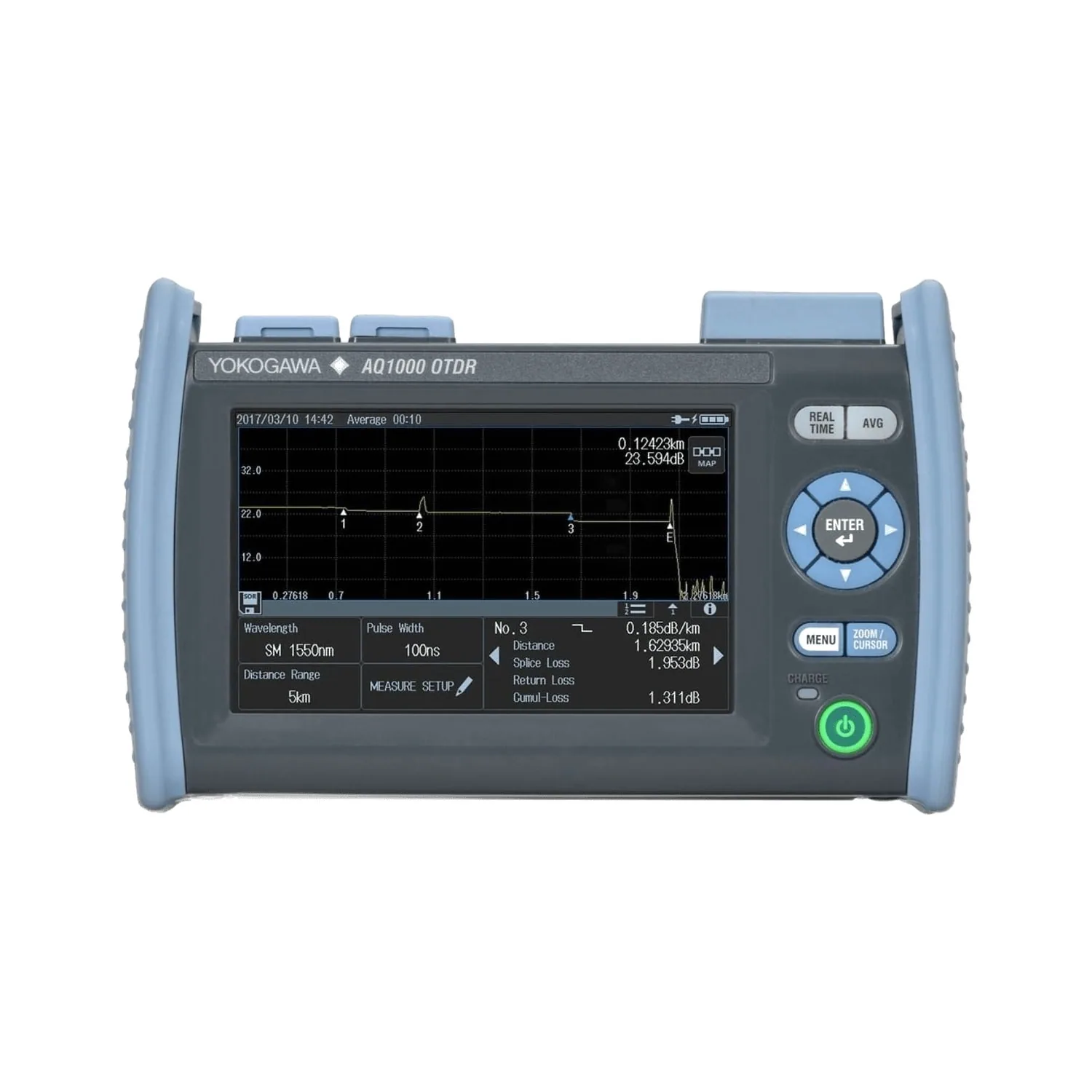
Compact, battery-powered instruments (EXFO MAX-730C, Yokogawa AQ1000, VIAVI SmartOTDR) optimized for field-technicians doing FTTH and access-network testing. They typically offer 1310/1550 nm, dynamic range of 32–40 dB, and built-in light source, power meter, and visual fault locator.
Modular / High-Performance OTDR
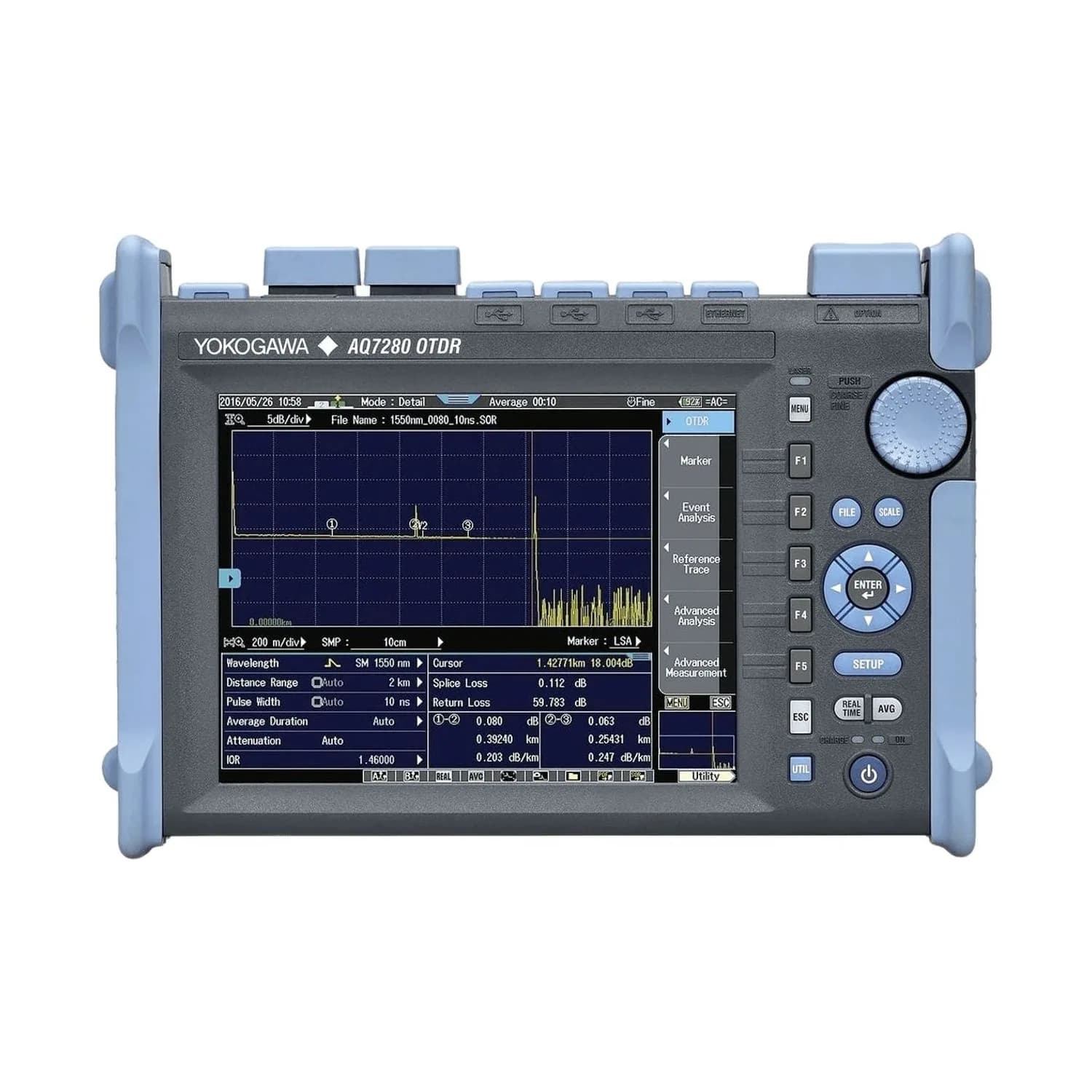
Platform-based instruments such as the EXFO FTB-4 Pro or Yokogawa AQ7280 accept plug-in modules with dynamic range up to 50 dB, PON / long-haul / CWDM filters, and short dead zones (≤ 0.5 m) for dense interconnects.
How to Choose the Right OTDR
- Wavelengths: 1310/1550 nm for standard SM; add 1625/1650 nm for in-service testing and macrobend detection; 850/1300 nm for MM.
- Dynamic range: 32 dB for FTTH, 40 dB for metro, 45+ dB for long-haul and PON.
- Dead zone: short event dead zones (≤ 1 m) matter for short patch cords and data center fiber.
- Workflow: tap-based UI, automatic macro/event recognition and bi-directional analysis save hours per site.
- Reporting: native .sor files, cloud sync and one-click PDF acceptance reports.
OTDR vs Other Fiber Test Tools
A light source + power meter gives you only end-to-end insertion loss. A visual fault locator shows obvious breaks within a few kilometers. Only an OTDR gives you a full loss map of the link — distance, event-by-event loss, and reflectance — which is required for most carrier and enterprise acceptance specs.
Conclusion
Choosing the right OTDR is about matching wavelengths, dynamic range and dead zone to your real network segments. For most FTTH contractors, a handheld SM OTDR at 1310/1550 nm with 32–37 dB dynamic range is the sweet spot; backbone and data center teams benefit from modular platforms.
Need help choosing an OTDR?
We stock EXFO, Yokogawa and VIAVI OTDRs. Share your network details and we'll recommend the best model and configuration.